
Most of us have been conditioned to think about vacations the same way.
Work hard.
Push through.
Save your vacation days.
Then reward yourself with one big trip at the end of the year.
There’s just one problem.
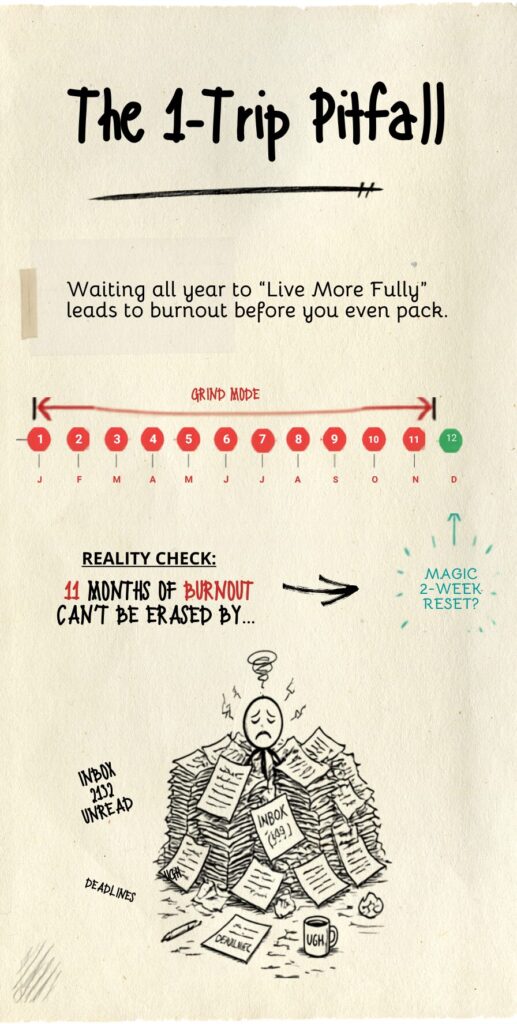
By the time that vacation finally arrives, many of us are already mentally and physically exhausted.
Growing research suggests there may be a healthier approach. Rather than viewing travel as one annual reward, we may be better served by treating it as regular maintenance for our physical and mental well-being.
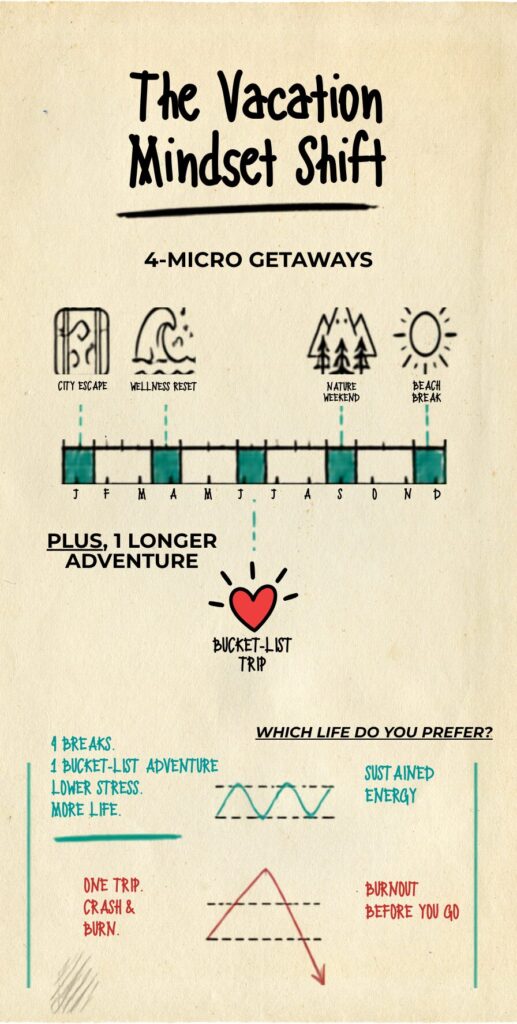
This isn’t about choosing between weekend getaways and bucket-list adventures. Both have value. The difference is how often you give yourself permission to pause. Instead of relying on one annual vacation to recover from months of stress, consider taking several shorter getaways throughout the year while still planning one longer bucket-list trip. By giving your mind and body regular opportunities to reset, you may reduce stress before it leads to burnout—and enjoy the best of both worlds: frequent renewal and unforgettable adventures.
Think of it less as escaping life—and more as maintaining your well-being.
The Hidden Cost of Waiting for “Someday”
Modern life rarely slows down.
Between work deadlines, family responsibilities, household tasks, endless notifications, and the pressure to always be productive, stress has become a constant companion for many people.
The problem isn’t simply feeling busy.
It’s that our bodies often stay in “go mode” for weeks or months without a meaningful opportunity to recover.
Over time, chronic stress keeps our body’s primary stress hormone—cortisol—elevated longer than it should be.
Cortisol plays an essential role in regulating blood pressure, metabolism, blood sugar, sleep cycles, energy levels, and our body’s response to stress. But when cortisol remains elevated for long periods, it can begin to work against us instead of for us.
Long-term stress has been linked to:
- Difficulty sleeping
- Mood changes
- Trouble concentrating
- Decision fatigue
- Increased blood pressure
- Weight gain
- Weakened immune function
- Chronic inflammation
- Burnout
In other words, the longer we postpone recovery, the harder our minds and bodies have to work just to keep up.
What Science Says About Vacations
The good news?
Recovery doesn’t require disappearing for two weeks.
Research consistently shows that even short vacations can provide meaningful benefits for both our mental and physical well-being.
Studies have found that taking time away from work can:
- Reduce perceived stress
- Improve mood
- Restore mental energy
- Improve work-life balance
- Increase overall life satisfaction
- Improve productivity after returning
- Boost happiness simply by anticipating an upcoming trip
Some researchers even suggest that the anticipation of travel can be almost as rewarding as the trip itself.
The takeaway is simple.
Your brain doesn’t necessarily need one massive escape.
It benefits from regular opportunities to reset.
Why Three-Day Weekends Can Be So Powerful
One of my favorite discoveries has been that meaningful travel doesn’t have to be far away or expensive.
Sometimes the most restorative trips are only a few hours from home.
A mountain cabin.
A lakeside retreat.
A nearby beach town.
A charming bed-and-breakfast.
A quiet hiking trail.
These “micro-getaways” interrupt the stress cycle before burnout has a chance to build.
They’re also easier to plan, require less money, and often use only one or two vacation days—especially when paired with holidays or long weekends.
That’s exactly why I created the Stress-Free Travel Planner. One of its features helps you maximize holidays and PTO so you can enjoy more restorative breaks throughout the year without using more vacation time.
Four Weekend Getaways vs. One Big Vacation
Imagine two travelers.
Traveler A waits all year for one two- or three-week vacation.
Traveler B takes four three- or four-day getaways spread throughout the year, along with one longer bucket-list vacation.
Both spend roughly the same number of days traveling.
But Traveler B experiences five opportunities to step away, recharge, reconnect with loved ones, and reduce stress before it becomes overwhelming.
Instead of asking one vacation to undo eleven months of accumulated stress, they’re giving their mind and body regular opportunities to recover before chronic stress and elevated cortisol have a chance to take hold.
That’s a completely different way of thinking about travel.
This Matters for Busy People
If you’re a parent…
A professional…
A caregiver…
Or someone who constantly says, “I’ll travel when things slow down…”
This approach was made for you.
You don’t need unlimited vacation time.
You don’t need a luxury budget.
You don’t even need to leave your state.
Sometimes what your mind and body need most is simply permission to pause.
What About 24-Hour Wellness Breaks?
If you’re fortunate enough to work for an employer that offers Wellness Days, take advantage of them. More organizations are recognizing that time to rest and recharge isn’t a luxury—it’s an investment in employee well-being.
But you don’t need a company-sponsored wellness day to give yourself permission to reset. If your schedule doesn’t allow for a long weekend, dedicate 24 hours entirely to your well-being. Spend a night at a nearby bed-and-breakfast, unplug at a state park, book a spa treatment — my favorite, or simply disconnect from work and everyday responsibilities.
Think of it as a wellness day rather than a vacation—a small investment that can help you recharge between your longer getaways. While it’s not a replacement for travel, it can be another powerful way to interrupt the stress cycle, prevent burnout, and make regular renewal part of your lifestyle.
Travel Isn’t Escaping Life—It’s Maintaining It
One of the biggest misconceptions about travel is that it’s a luxury reserved for special occasions.
I see it differently.
Travel is preventive self-care.
It’s maintenance for your mind and body.
It’s an investment in your relationships.
It’s a chance to reconnect with nature, yourself, and the people you love.
Long vacations will always have their place, especially for those once-in-a-lifetime bucket-list adventures.
But don’t underestimate the power of a long weekend or a nearby escape.
Science increasingly suggests that regular, intentional breaks may help you think more clearly, reduce stress, improve your overall well-being, and return home feeling renewed—not just once a year, but all year long.
So instead of asking,
“When can I finally take my vacation?”
Try asking,
“When can I take my next reset?”
Because travel isn’t just about escaping life.
It’s about maintaining the life you’ve worked so hard to build.
That’s the philosophy behind Live To Travel.
Travel More. Stress Less. Live More Fully.
Not by taking more vacation days—but by taking more opportunities to reset.